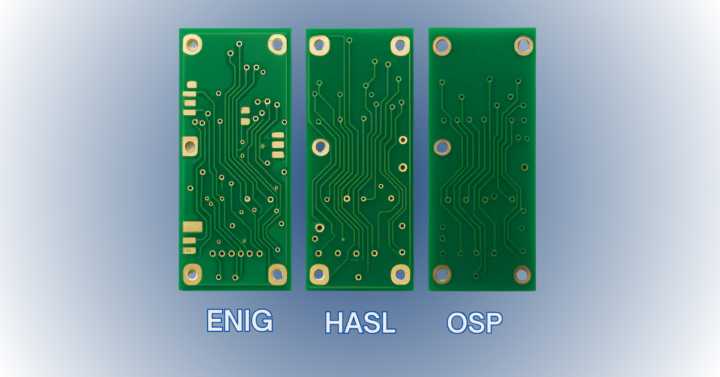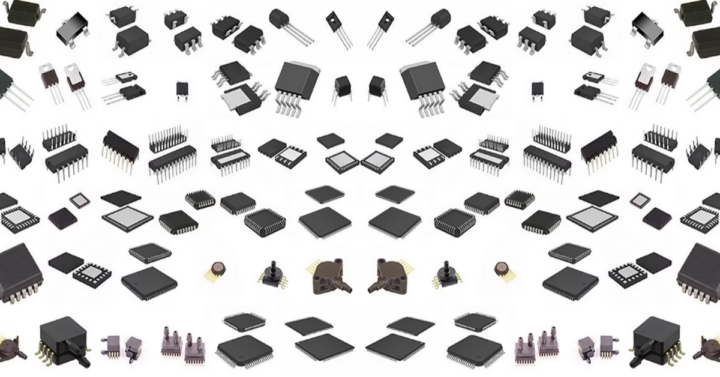

We would like to provide a brief overview of the current U.S. tariff treatment applicable to products imported from Colombia and China.
Under the U.S. Harmonized Tariff Schedule (HTS), imported products are assigned a tariff classification that determines the applicable duty rate according to the product’s country of origin.
Countries receiving Normal Trade Relations (NTR) status are generally subject to the Column 1 (General) duty rate, while Column 2 applies to countries that do not receive Normal Trade Relations.
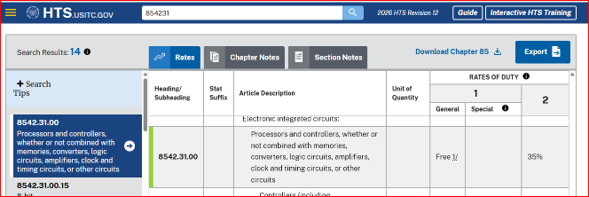
To interpret tariff rates correctly, one must check the country of origin for imports into the USA.
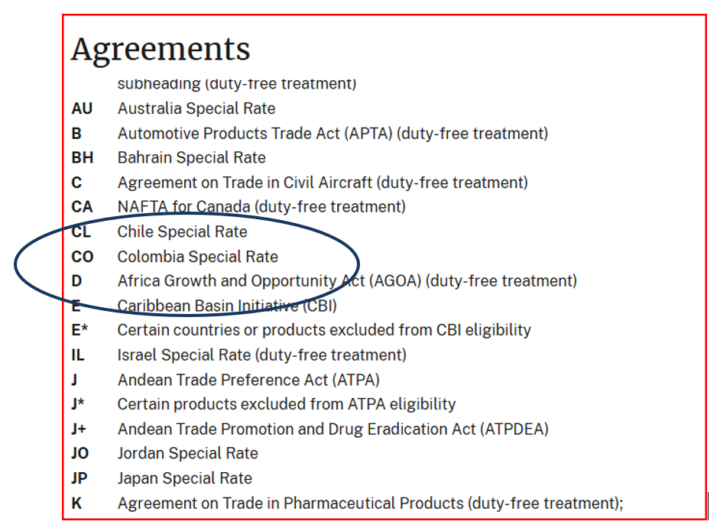
Countries subject to special rates under Column 1 include, among others:
However, products of Chinese origin may be subject to additional duties under Chapter 99 of the HTS. (Column 2). These additional duties are established through specific U.S. trade measures, including the Section 301 actions, and must be declared together with the base HTS classification. As a result, the effective duty is determined by the combination of the product’s HTS classification, its country of origin, and the applicable Chapter 99 provision in effect at the time of importation.
Based on the current HTS provisions applicable to these products, the effective import duties are as follows:
8542.31 (Integrated Circuits):
Colombia: 0%
China: 35%
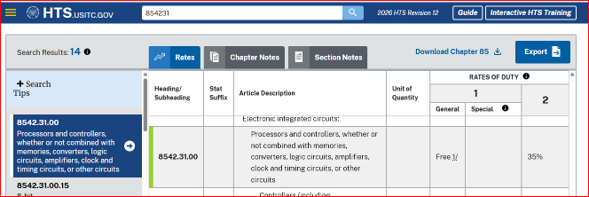
8471.6020 (Membrane Panels):
Colombia: 0%
China: 35%
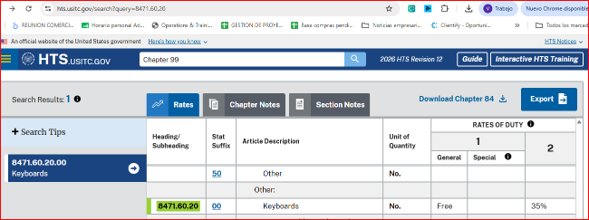
Since U.S. trade measures may change over time, importers should always verify the applicable Chapter 99 provisions and duty rates in effect at the time of importation.

As for the cut-off date for this analysis, the tariff stood at the level indicated by the recorded data.
In conclusion, as shown in the HTS “Special” column, Colombia (CO) is included among the countries eligible for preferential tariff treatment, while China is not. This difference can have a significant impact on the total landed cost of the product.
Therefore, evaluating a manufacturing alternative should not be based solely on the EXW unit price. The total landed cost—including tariffs, logistics, inventory availability, and operational flexibility—provides a more accurate basis for comparison.
We compared the logistics costs of shipping products directly from China to the United States versus shipping from China to Colombia for manufacturing and then exporting the finished product to the U.S. by air.
Our analysis shows that the freight costs are remarkably similar. When the applicable tariff treatment is included, the overall landed cost becomes highly competitive.
Analysis with reference prices for 1,000 units of a product
|
Concept |
China |
Colombia (Bixtia) |
|
Manufacturing Cost (Exw – at origin) per unit |
USD 2.85 |
USD 3.73 |
|
Estimated Import Tariff |
35% |
0%* |
|
Air Freight |
China – USA: USD 1200 |
China-Colombia (Row Materials) and Col – USA (final producto): USD 1350 |
|
Estimated Landed Cost (it includes the unit price, Import Tax an Freight) |
USD 5.468 |
USD 5.080 |
*Tariff Of Colombia: Even if, due to an international policy decision, the rate was set at 10%—as it was during the Petro administration—Colombia would still retain the advantage.
Now, under the new Colombian government, it is expected that a 0% tariff will be maintained for these tariff lines.
Beyond the cost comparison, manufacturing in Colombia provides several operational advantages:
- Flexibility to ship partial orders when needed.
- Direct DHL shipments from Medellín to the U.S. with approximately 3-day transit time.
- Immediate support for repairs, warranty service, and product updates.
- Technical support in the same language and compatible business hours.
- Faster response to engineering changes and urgent customer requests.
- A manufacturing partner located much closer, providing greater supply chain flexibility and operating in the same time zone.
Colombia offers much more than a competitive manufacturing cost. It provides responsive, flexible, and geographically strategic manufacturing.
This is one of the reasons why many companies are evaluating alternative manufacturing locations nearshoring in Colombia, to reduce the overall tariff impact while maintaining supply chain flexibility and responsiveness.
We believe a pilot order represents the most effective way to evaluate the benefits described in this analysis. It provides an opportunity to validate not only commercial assumptions, but also our quality, responsiveness, and technical support under real operating conditions.
Prepared by:
Bixtia Commercial and Foreign Trade Management